November 19, 2026
Business Process Automation Consultants: What They Do
Business process automation consultants are outside specialists who find the manual, repetitive steps in how your company works, redesign them, and build the workflows that replace them. They are not...
Written by Frankwin Hooglander
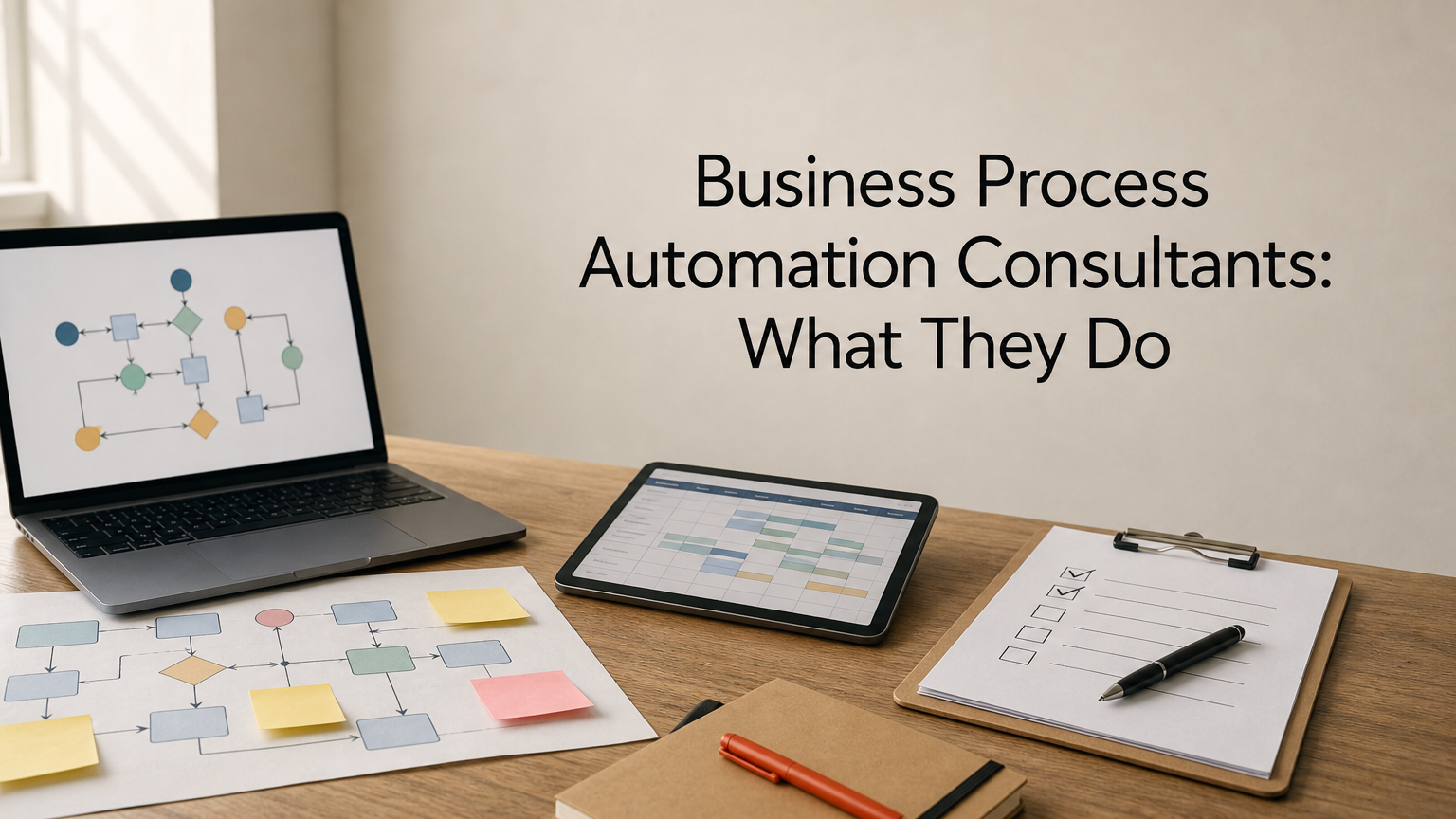
Business process automation consultants are outside specialists who find the manual, repetitive steps in how your company works, redesign them, and build the workflows that replace them. They are not software resellers. A good business process automation consultant maps a process like lead follow-up or invoicing, decides what to fix before anything gets automated, then builds, tests, and hands over a system your team can run without them.
This guide covers why companies hire them, how an engagement runs from first call to ongoing support, which processes get automated first, and how to choose a consultant and know what to pay.
HSP Automation does this work for home service and trades companies on platforms like Housecall Pro, ServiceTitan, and Jobber, so many examples here come from field service. The method applies to any small or midsize business.
Why hire business process automation consultants
Hire one when you know work is slow but cannot tell which steps cause it. A consultant sees the whole flow, picks the steps worth automating, and builds them correctly the first time. A software subscription alone will not do that.
They fix the process before they automate it
Automating a broken process only produces mistakes faster. That is the main thing a consultant adds. Before touching any software, they trace how a job, lead, or invoice moves through your company and look for the usual symptoms: double entry, disconnected systems, approvals stuck in email, handoff gaps, and leads that wait hours for a reply.
Then they decide what to remove, what to simplify, and only after that what to automate. Business automation consulting is as much process design as it is technology. Most of the value comes from the steps that disappear, not from the tools that run what is left.
Automation multiplies whatever process you give it, so the process has to be right first.
What the saved time is worth
Say your office manager spends 10 hours a week re-keying finished jobs into accounting and chasing quote follow-ups. At a loaded cost of $30 an hour, that is 10 × $30 × 52 = $15,600 a year spent on work a workflow can do. At 20 hours a week, the figure doubles to $31,200. HSP Automation puts typical savings for trades companies at 10 to 20 hours of administrative work per week, depending on volume and setup.
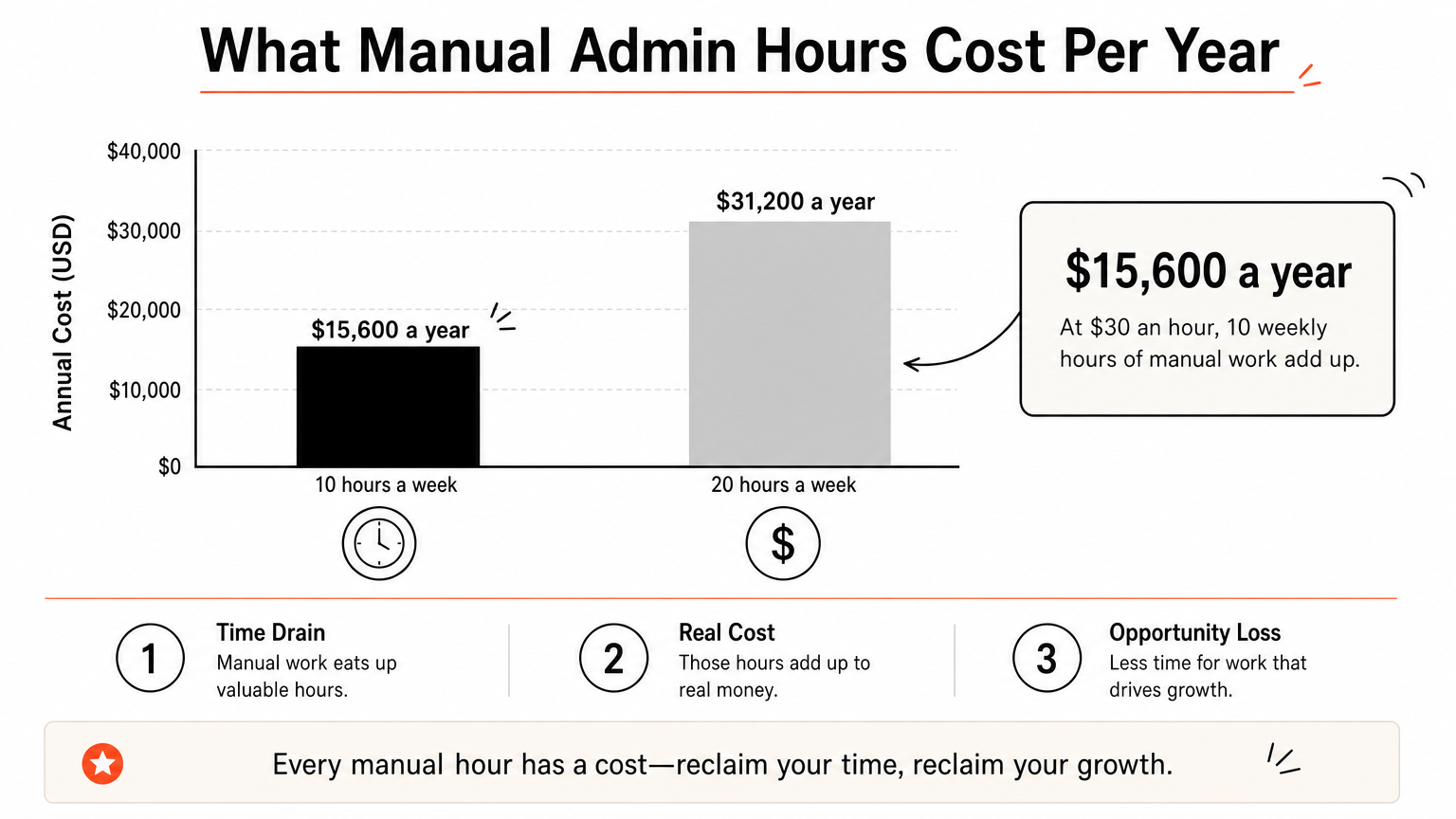
Your own number will differ, so plug in your hours and your rate. The same math sets a ceiling on what a project is worth paying for. Also count the costs that never show on payroll, such as leads lost to slow replies and invoices that go out late.
How a consultant engagement works from start to finish
Most engagements follow six stages: discovery, prioritization, redesign, build, testing, and training with support. The names vary by firm, but the order rarely does, and a consultant who skips discovery or testing is a warning sign.

The six stages
| Stage | What the consultant does | What you provide |
|---|---|---|
| Discovery | Interviews staff, maps the current workflow, lists every tool in use | Access to the people who do the work |
| Prioritization | Ranks processes by volume, clear rules, and payoff | Goals and a budget range |
| Redesign | Removes extra steps and handoffs | Sign-off on the new flow |
| Build | Connects systems and sets up workflows, using tools such as Zapier, Make, API connections, or custom code | Account access and logins |
| Testing | Runs real cases and checks errors and exceptions | Feedback from daily users |
| Training and support | Writes documentation, trains staff, monitors the system | Staff time for training |
How long it takes and what you do
Timelines depend on how many systems are involved. At HSP Automation, simple integrations can be ready in a few days, most setups finish in 1 to 2 weeks, and complex multi-system builds run 3 to 4 weeks including training. Custom software is a different scale. Simple internal tools usually take 4 to 8 weeks.
Your job is smaller than most owners expect. You make decisions, grant access, and give honest feedback during testing. A strong consultant handles the technical setup, so you need no technical background. Ask for training and documentation up front, because a workflow nobody understands will quietly be abandoned.
A consultant should map, test, and train as carefully as they build.
Which processes consultants automate first
Consultants start with high-volume, rule-based work that has clear inputs, because results show fastest there. If a task repeats daily and a person follows the same steps each time, it is a candidate.
Good first candidates
For a trades company, the usual starting list looks like this:

- Lead response: an instant text and email reply to every new inquiry
- Quotes and invoices: documents sent automatically when a job reaches a set status
- Scheduling and dispatch: technician routing and customer notifications
- Accounting sync: job data, invoices, and payments flowing into QuickBooks
- Follow-up: review requests and reminders after a completed job
- Onboarding: paperwork and training steps for new hires
In other industries the same pattern shows up as invoice processing, CRM updates, report generation, and approval routing.
What to leave alone for now
Skip anything that needs judgment on every case, happens rarely, or is still changing. Also hold off when your data is messy. Automation applies rules to whatever it receives, so duplicate customer records or inconsistent job types will spread errors across your systems. A good consultant will tell you to clean the data first, even though it delays the build.
Start with work that repeats daily and follows the same steps every time.
How to choose and price business automation consultants
Choose the consultant whose experience matches your tools and company size, and who tells you the price before work starts. A firm built for large enterprise programs is usually the wrong fit for a 20-person service company, and the reverse is also true.
Four types of provider
| Type | Best for | Watch for |
|---|---|---|
| Large strategy firms | Enterprise-wide programs with governance and compliance needs | Cost and scope far beyond a small company's needs |
| Specialist boutiques | Small and midsize teams on specific platforms | Confirm they know your exact software |
| Freelance marketplaces | One clearly defined project | You manage the work, and support after delivery is unclear |
| In-house hire | Constant, ongoing automation needs | Salary cost and a single point of failure |
Questions to ask before you sign
- Have you automated this process on this platform before?
- How will you map our workflow before building anything?
- Who tests the automation, and how?
- What training and documentation do we get?
- Who fixes it when an integration breaks, and how fast?
- Do we own the workflows and custom code?
Vague answers to the last three tell you the most. Automations break when apps update their connections, so ongoing monitoring matters as much as the initial build.
How pricing works
Consultants charge in three ways: hourly rates, a fixed price per project, or a monthly retainer. Hourly suits open-ended advisory work. Fixed pricing suits a defined build. Retainers suit ongoing maintenance and improvement. Whatever the model, insist on a written scope.
For reference, HSP Automation's clients mostly pay $97 to $500 per month depending on scope, plus a one-time setup fee. Its Housecall Pro Zapier integration runs $147 per month plus a $147 setup fee. For strategic work, it offers a 2-hour strategy session, a technology audit, and a monthly advisory retainer. Treat any quote that arrives without a scope as incomplete.
Get a written scope and price before any work begins.
Choosing your next step
Business process automation consultants earn their fee by fixing the process first, then building, testing, and supporting the automation. Match the provider to your size and software, ask who maintains the system, and get a written scope with a price.
If you run a home service or trades company, book a free 30-minute strategy call with HSP Automation to find out which of your processes are worth automating first.