November 10, 2026
Local SEO for Contractors: How to Rank in Google Maps
The fastest way to do local SEO for contractors is to work four levers in order. Complete your Google Business Profile, build one web page for each service and city you cover, earn steady reviews with...
Written by Frankwin Hooglander
The fastest way to do local SEO for contractors is to work four levers in order. Complete your Google Business Profile, build one web page for each service and city you cover, earn steady reviews with consistent listings, and check calls and rankings every month. Do those well and your business starts showing up in the map results for searches like "roof repair near me," usually within three to six months.
You already know the frustration. You are on a job site all day, and a competitor with fewer years in the trade sits above you in Google Maps. Agencies quote vague monthly fees, and most online advice is written for restaurants and dentists, not for a crew that works inside a set service radius.
This guide treats each lever as a step you can act on, with costs, timelines, a title tag formula, and a review-request text you can copy. HSP Automation builds websites, Google Business Profiles, and local search campaigns for home service companies, so the advice comes from that day-to-day work.
Why local SEO pays off and what it costs
How Google decides who shows up nearby
Google says local results rely mainly on relevance, distance, and prominence. Relevance is how well your profile and website match what the person typed. Distance is how close you are to the searcher or the place named in the search. Prominence is how well known you are, based on reviews, links, and mentions around the web.
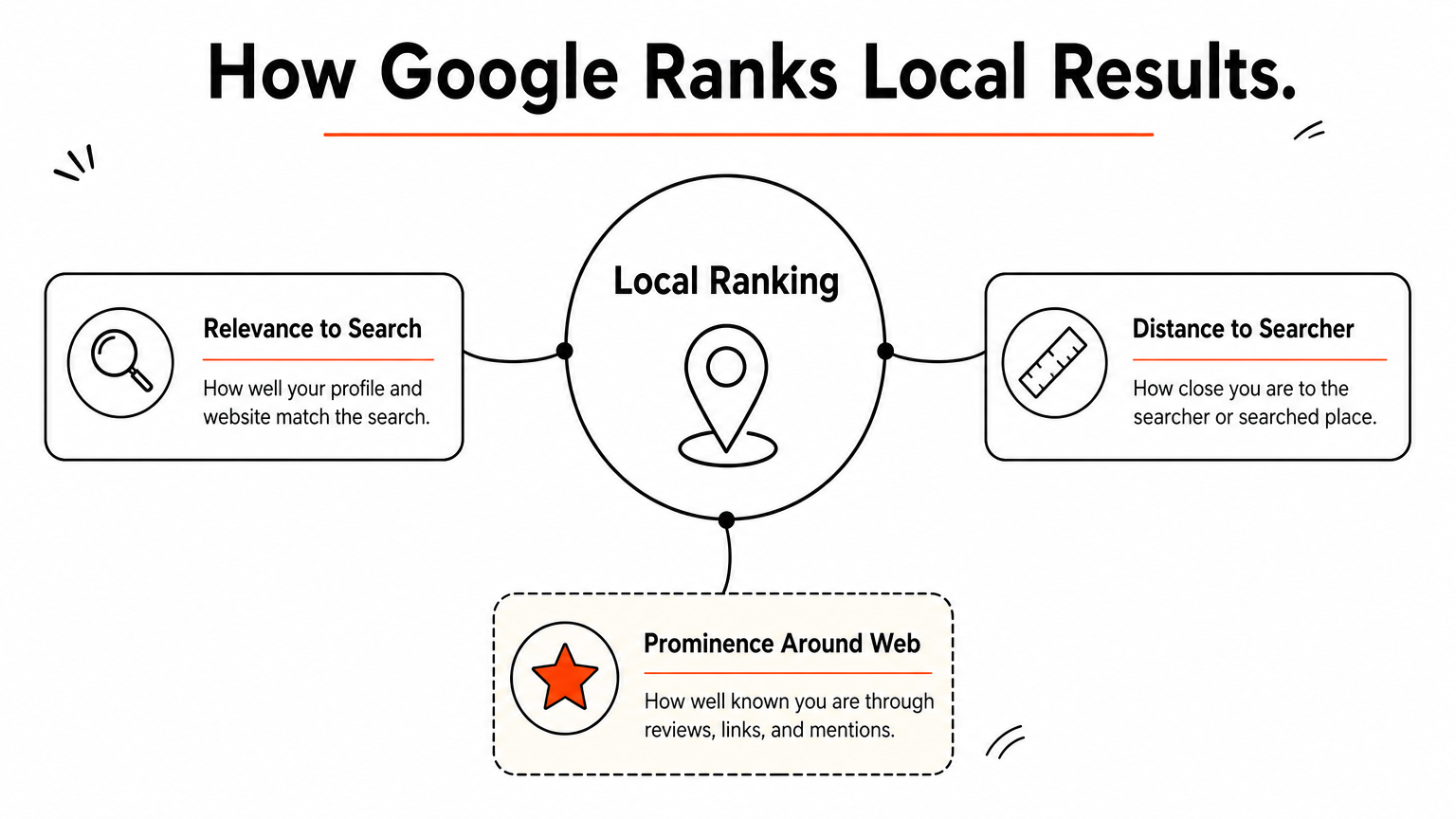
You cannot move your shop, so you win on the other two. That is why a smaller contractor with a complete profile, focused pages, and fresh reviews can beat a larger company that neglects all three.
You cannot change distance, so local SEO is the work of improving relevance and prominence.
What local SEO costs and how long it takes
Doing it yourself costs time, a one-time optimization project starts around $1,500, and a monthly retainer runs $500 to $2,000 depending on competition. The figures below are HSP Automation's pricing for its SEO & Local Search service. Other providers price differently, so compare scope as well as the fee.
| Route | Typical cost | Best for |
|---|---|---|
| Do it yourself with this guide | $0 plus your time | Low-competition areas, owners who like to tinker |
| One-time optimization project | From $1,500 | Fixing the profile and site once, then maintaining in-house |
| Monthly SEO and local search | $500 to $2,000 per month, typically $750 to $1,500 for local home service | Competitive markets that need ongoing work |
Expect first movement in 3 to 6 months and significant results by 6 to 12 months. Here is a payback example. At $1,000 per month and a $600 average job, you need two extra jobs a month to cover the fee, which is $12,000 in fees over the first year. Local SEO is still worth it in 2026 when your area has steady search demand and you do that math before you sign.
Step 1. Optimize your Google Business Profile
Claim the profile and choose the right categories
Claim and verify your profile at business.google.com. Your primary category carries the most weight, so pick the most specific one available, such as "Roofing contractor" or "HVAC contractor." Add secondary categories only for services that bring real revenue. Use your real business name. Stuffing keywords or cities into it breaks Google's guidelines and can get the profile suspended.
If you work out of a truck or home office, set the profile up as a service-area business. Hide your home address and list the cities you actually serve, up to 20 areas. Never use a PO box or a virtual office as your address.
Fill in every field and keep it active
An incomplete profile gives Google less to match against a search. Work through this list once, then keep it fresh:

- Services: add each service with a one-sentence description and a price range if you can.
- Business description: name your trade and main cities in plain language.
- Hours: include emergency or after-hours availability.
- Photos: upload real shots of finished jobs, your crew, and your trucks, and add a few every week.
- Posts: share a recent project or seasonal reminder every week or two.
If Google suspends your profile, do not open a duplicate. Gather proof that the business is real, such as a license, insurance, and photos of your branded vehicle, and submit a reinstatement request.
A complete, active Google Business Profile is the single biggest lever for appearing in the map results.
Step 2. Build a page for each service and city
Give every service and city its own page
Create one page for each core service, such as "Water heater replacement," and one page for each city where you want calls. Each page must be genuinely different. Copying one page fifteen times and swapping the city name is thin content and ranks poorly. Add a real project photo from that city, the neighborhoods you have worked in, your process, what drives the price, and three to five questions customers actually ask.
Write each title tag with the same pattern, and keep it near 60 characters so Google does not cut it off:
[Service] in [City], [ST] | [Company]
Put your phone number at the top of every page as a tap-to-call link.
Fix the technical basics
Most homeowners search on a phone, so page speed and mobile layout matter as much as the copy. Run your site through the Free Website Grader for Contractors. The scan takes about 60 seconds, needs no credit card, and scores speed, SEO, mobile usability, security, and trust signals. Fix the lowest scores first.
Then make your business name, phone number, and service area read exactly the same in your footer as they do on your Google profile. Add LocalBusiness structured data so search engines can read those details without guessing.
Service pages and city pages tell Google which jobs you want and where you want them.
Step 3. Earn reviews and consistent listings
Ask for a review after every finished job
Ask the day the job ends, while the customer is happy, and send a direct review link by text. You can copy a review share link from your Business Profile. Never pay for reviews, offer discounts in exchange, or ask only your happiest customers, because Google's policies prohibit incentives and review gating.

Copy this message and fill in the brackets:
Hi [Name], this is [Your Name] from [Company]. Thanks for letting us handle your [service] today. If you have 30 seconds, a Google review helps your neighbors find us: [review link]
Reply to every review within a couple of days. Mention the work naturally, such as "Glad we could replace your water heater same day, Maria." Replies show future customers that someone is paying attention.
Keep your name, address, and phone consistent
Listings on other sites are called citations. Claim your business on Apple Business Connect, Bing Places, Yelp, and Facebook, then add your trade association and local chamber of commerce. Use the identical business name, phone number, and service area wording on each one, because mismatches make it harder for Google to trust which business is yours.
Local links add prominence too. Sponsor a youth team, join a supplier's installer directory, or get mentioned by a local news site. A handful of relevant local links beats dozens of random directory links.
Consistent listings and a steady flow of fresh reviews are how you build prominence.
Step 4. Track calls and rankings, then adjust
Track calls, not just rankings
Open your Business Profile performance data and compare calls, website clicks, and direction requests month over month. Rankings shift with the searcher's location, so check from several spots in your service area instead of from your office. Ask every new caller how they found you and write it down. That answer is your most honest report.
Rankings only pay if someone answers. An instant text reply to missed calls and web forms keeps the lead before a competitor calls back. HSP Automation's lead response systems do this within seconds, from $97 to $297 per month.
Run a 30-minute monthly review
Set a recurring slot and go through the same checklist each time:
- Count new reviews and reply to any you missed.
- Compare Business Profile calls to the previous month.
- Check which service and city pages get impressions in Google Search Console.
- Publish one new project page or profile post.
- Fix any listing that shows an old phone number or address.
Give changes at least 3 months before judging them. Local SEO compounds slowly, and the contractors who keep doing this checklist are the ones still climbing in month ten.
Local SEO is a monthly habit, and the contractor who keeps the habit is the one who keeps the ranking.
Where to start
Local SEO for contractors comes down to a complete profile, focused service and city pages, honest reviews, and a monthly look at the numbers. Start with the profile, since it costs nothing and moves fastest, then add pages and reviews as you go.
If you would rather hand the work off, talk to HSP Automation about local search. We will look at your profile and site, tell you what the work costs before it starts, and show you what to fix first.